The Advice Every Artist Hears
Anyone who has taken a painting class has heard the same advice. Step back from the canvas. Let a piece rest overnight. Come back with fresh eyes and fix what bothers you. It is good advice. I give it constantly to students who paint with me on canvas.
But it does not apply to the other half of my work. When I sit down to write a Torah scroll, a mezuzah, or a set of tefillin, that whole approach breaks down. There is no stepping back to reconsider a letter once it is written correctly. There is no revising for taste. The rules are not mine to set, and they are not flexible.
Why a Torah Scroll Breaks That Rule
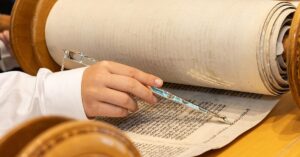
A Torah scroll has to be written in a fixed order, letter by letter, with specific intention at the moment of writing certain names. You cannot skip ahead and come back. You cannot write a section out of sequence because the light is better that day or the ink is flowing well. If a letter is written correctly and is halachically valid, going back to change it just because it looks slightly different from the one before it is not allowed.
This is the opposite of how I was taught to think as a painter. In art, inconsistency inside a piece can be a problem you fix. In scribal work, a certain amount of natural variation between letters is expected, and forcing uniformity by reworking a valid letter would actually be the mistake.
What Continuity Actually Requires
The standard creative advice assumes you can pause, judge, and adjust. Scribal work asks for something closer to a musician playing a piece from memory. You prepare for years so that when you sit down, the letters come out right the first time, in order, without a pause that breaks the flow of a name of God or a full word.
That means the real skill is not in fixing mistakes after the fact. It is in the years of practice that make mistakes rare, and in knowing the specific rules for the few mistakes that can be corrected and the ones that cannot. A sofer spends far more time preparing than most people realize, precisely because there is so little room to fix things once the pen touches the parchment.
Where I Can Still Revise
None of this means a scribe never checks work. Checking happens, but it happens differently than in painting. Instead of standing back and asking “do I like this,” the question is narrower: is this letter formed the way tradition requires, is it complete, is it legible on its own. That is a technical check against a fixed standard, not a personal judgment call.
On canvas, I get to have opinions about my own work. On parchment, my opinions matter much less than the standard I am writing against. That difference took me a long time to fully separate in my own mind, because both crafts use a similar hand and a similar kind of focus.
What This Teaches Beyond the Page
I think most fields have a version of this. There is general good advice that applies almost everywhere, and then there is a smaller set of situations where that advice is exactly wrong because something more fixed is at stake: a legal document, a medical procedure, a safety check. In those cases, the person doing the work has to know when to set the usual instincts aside.
For my students, I still teach the painter’s habits: slow down, look again, be willing to change something that is not working. Those habits make better painters. But when I am at my own writing table working on a scroll, I use a different set of habits entirely, ones built around order, preparation, and getting it right the first time rather than revising it later.
Knowing which situation you are in, and which set of rules actually governs it, matters more than knowing either set of rules perfectly. That is as true outside my work as it is inside it.