The Question Behind the Question
People who ask me how to become a scribe usually mean something else. They want to know how long it takes before you feel ready. The honest answer is that you don’t. You just get to a point where your teacher trusts your hand more than you do, and that has to be enough for a while.
If someone came to me tomorrow and said they wanted to start, here is what I would actually tell them.
Learn the Letter Before You Learn the Word
The instinct is to want to write something meaningful right away, a verse, a name, a blessing. Resist that. The first months are not about meaning. They are about the shape of a single letter, over and over, until your hand stops thinking about it.
Hebrew calligraphy has rules for the exact proportion of every stroke, where a letter can touch another and where it cannot, how much space belongs around it. None of that comes from reading about it. It comes from writing the same letter a few hundred times on paper nobody will ever use, until your hand knows the rule better than your memory does.
I still see beginners rush this part. They want to feel like a scribe faster than the craft allows. The ones who slow down here end up faster later, because they are not constantly fixing bad habits they built too early.
Find Someone Who Will Correct You Out Loud
Books and diagrams can show you what a letter is supposed to look like. They cannot tell you why yours is wrong. That takes a person sitting next to you, watching your hand move, stopping you mid-stroke.
I was fortunate to learn under teachers who did not soften their corrections. If a letter was off, I heard about it plainly, not gently. That is a gift, even when it doesn’t feel like one at the time. A student who is only ever told their work is good has no way of knowing when it actually is.
If you are starting out, find a teacher who will tell you the truth about your work every single time, not just when you ask.
Expect the Boring Years
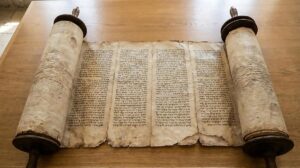
Nobody wants to hear this part, but it needs saying. There are years where you are not writing anything that will end up in a Torah scroll, a mezuzah, or tefilin. You are practicing. You are copying. You are being checked by someone more experienced than you, again and again, until the mistakes stop showing up.
This stretch feels slow because it is slow. But a scroll that will sit in a synagogue for a hundred years, that people will read from every week, is not something you get handed the tools for after a few enthusiastic months. The waiting is part of the training, not separate from it.
Craft Comes Before Art
I paint as well as write, and I get asked sometimes whether the art side should come first for a beginner, since it feels more expressive. I would say the opposite. Learn the discipline of exact, repeatable letters first. The freedom to interpret, to bring your own hand and eye into the work, means much more once you have already mastered the version of the craft that leaves no room for interpretation at all.
A scribe who skips the strict years and goes straight to expressing themselves usually produces work that looks interesting and fails the parts that matter most: the letters that must be formed a precise way for the writing to be considered valid at all.
What I Would Actually Say to Someone New
If someone asked me directly, I would tell them this. Do not chase the feeling of being a scribe. Chase the thousandth repetition of a letter you already think you know. Find someone willing to correct you without flattering you. Expect years before anyone hands you a real piece of parchment for real use, and do not resent those years, because they are the whole reason your hand will eventually be trusted with something permanent.
The craft rewards patience more than talent. I have seen talented people quit before they were any good, and I have seen patient people become excellent at something they were only average at when they started.